FASTBAR: Fast Release Fuel
When you're exercising, there comes a point where the energy you've got stored isn't enough to comfortably carry you through the session. That's when having a practical source of carbohydrate can make a difference.
For us, that's where FastBar comes in.
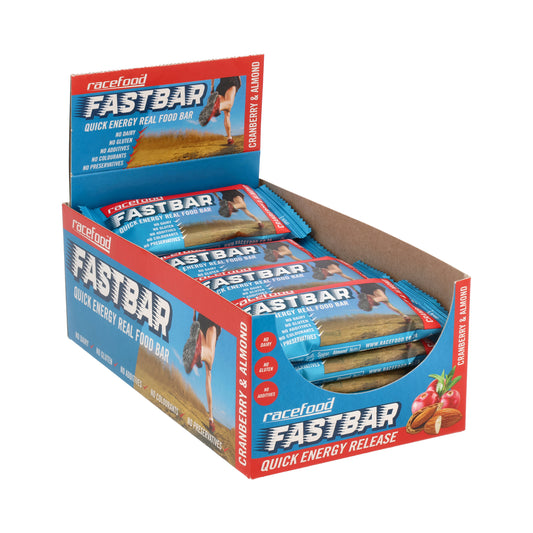
FastBar is designed around quick, accessible energy, making it particularly useful during higher-intensity training, shorter endurance sessions and moments when we need a top-up without slowing down. Racefood describes FastBar as its quicker-energy option, while athletes on the site use it for everything from hockey and gym sessions to endurance racing.
When should you take a FastBar?
The biggest mistake we can make with fuelling is waiting until we're completely empty.
If we're exercising for long enough that we need additional fuel, it makes more sense to start before we're exhausted. Exactly when and how much depends on the duration and intensity of the session, as well as what our stomach can comfortably handle.
For a shorter, high-intensity session, FastBar can work as a pre-session top-up or during the session when we need some additional carbohydrate.
For longer events, it can become part of a broader fuelling plan.
Racefood's own Two Oceans guidance, for example, recommends introducing FastBar around the 35–45 minute mark for a roughly two-hour half marathon, while longer efforts can combine FastBar with FarBar to provide different types of energy throughout the event.
Don't wait until you're running on empty
Fuelling is about staying ahead of the problem.
When we're deep into a hard session and suddenly realise we're out of energy, getting fuel in at that point isn't necessarily going to make us feel immediately better.
Instead, think about your nutrition before you start.
Know roughly how long you're going to be exercising, consider the intensity and have your fuel accessible. For longer sessions, practise your strategy during training so you know what works for you.
FastBar during different sports
FastBar isn't only for endurance athletes.
Racefood's athletes use it across different sports. The SPAR South African Women's Indoor Hockey Team, for example, uses FastBar around high-intensity gym, conditioning and shorter sessions. Rugby player Gustav du Rand describes using a FarBar before a game and a FastBar at halftime.
That's the important distinction.
You don't need to be running a marathon to think about fuelling. If you're doing repeated high-intensity work and need carbohydrate during your session, having something easy to consume can be useful.
Practise before race day
The best fuelling strategy is one you've already tested.
Take FastBar on your training sessions. Work out when you prefer to eat it, how much feels comfortable and how it fits alongside your normal hydration.
Don't leave your nutrition strategy until race morning.
Your body needs to be familiar with what you're giving it.
Keep it simple
For us, FastBar isn't about making sports nutrition complicated.
It's about having a practical source of energy available when training demands more from us.
Start before you're empty. Fuel consistently. Practise your strategy. Then get back to the work.