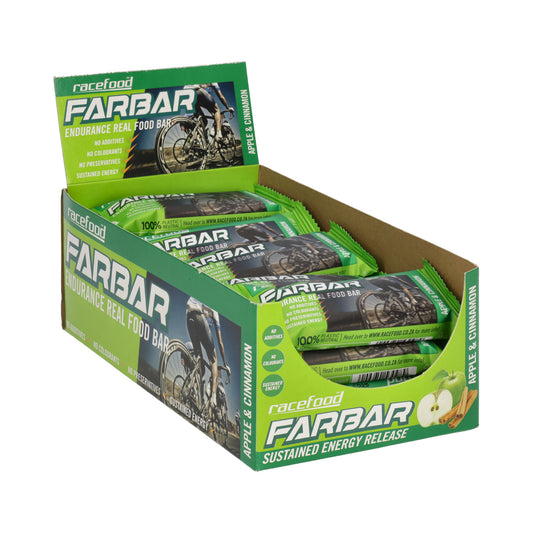
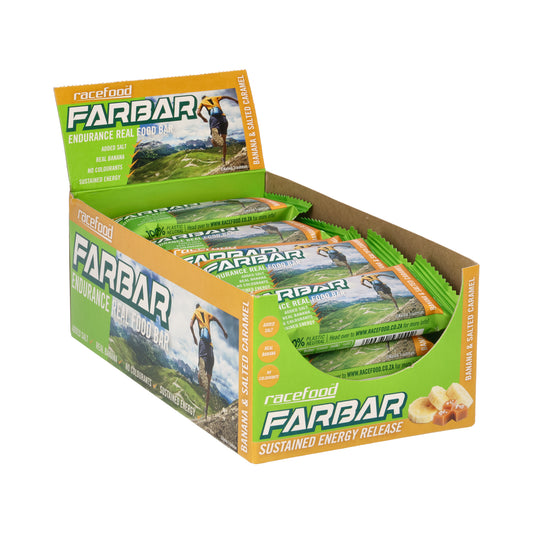
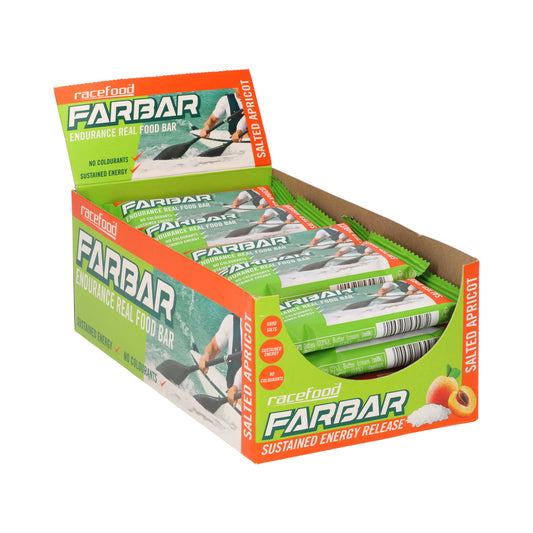
FARBAR: Whole-Food Sustained Energy
Long training sessions are different.
Whether we're cycling, paddling, running, racing or spending hours on the field, the challenge isn't just producing energy for a few minutes. It's managing that energy over a much longer period.
That's where FarBar fits into our fuelling strategy.
Racefood positions FarBar as the slower, more sustained energy option, making it particularly suited to longer efforts where we need to keep our energy topped up rather than looking for a quick hit.
Start fuelling before you feel empty
One of the biggest mistakes we see in endurance sport is waiting until we're hungry or exhausted before eating.
By then, we're already trying to catch up.
For longer sessions, Racefood recommends starting to fuel within roughly the first 30–45 minutes and continuing consistently, with the exact approach depending on the duration and individual needs.
FarBar can be useful as part of that steady approach.
Instead of waiting for the final part of a ride or run when fatigue has already set in, we can introduce fuel earlier and continue taking it throughout the effort.
When should you use FarBar?
FarBar is particularly suited to longer training sessions and endurance events.
Think long rides, extended paddles, long runs, multi-hour training days or competitions where we know we're going to be exercising for an extended period.
The SPAR South African Women's Indoor Hockey Team also uses FarBar during longer training days and extended sessions, while Racefood's Cape Town Cycle Tour guidance recommends FarBar as part of a strategy for maintaining energy across a 109km ride.
FarBar vs FastBar
The easiest way for us to think about the difference is simple:
FarBar = sustained energy.
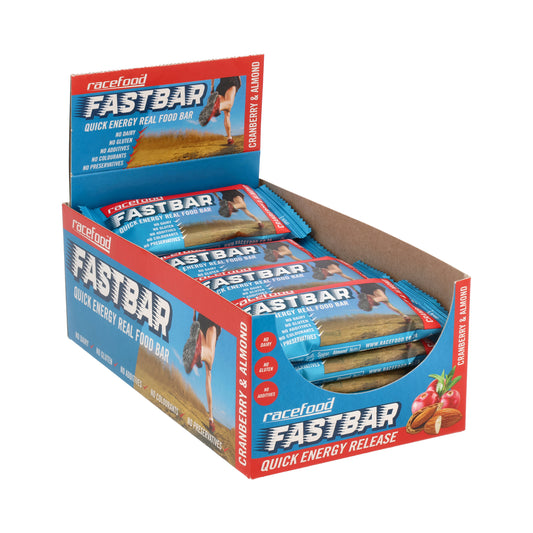
FastBar = quicker energy.
That doesn't mean one is universally better than the other.
They can actually work together.
For a longer event, FarBar can provide the steady foundation while FastBar can be introduced when we need a quicker top-up later in the session. Racefood uses this approach in its Two Oceans Half Marathon guidance, combining FarBar earlier with FastBar later for a longer three-hour effort.
Don't forget fluids
Fuel and hydration are separate parts of the plan.
Eating a FarBar doesn't replace the need to drink, particularly during longer sessions or in hot conditions. We need to consider the temperature, duration, intensity and how much fluid we personally lose through sweat.
For longer events, make a plan for both.
Train your gut
Just like we train our legs, lungs and muscles, we need to get comfortable with our fuelling strategy.
Try FarBar during your longer training sessions. Work out when you like to eat it, how much feels comfortable and how it fits with your fluid intake.
Racefood's advice is consistent across its endurance guidance: train with what you intend to use on race day.
That way, race day isn't an experiment.
The goal is consistency
Long-distance performance isn't about finding one magical product.
It's about putting together a system that works: sensible pacing, adequate hydration, appropriate carbohydrate intake, recovery and consistent training.
FarBar is one part of that system.
Start early. Fuel consistently. Keep the energy coming. Stay focused on the kilometres ahead.